Case study · Aquarate
A cup that had to survive the dishwasher. It went from 2% to 97%.
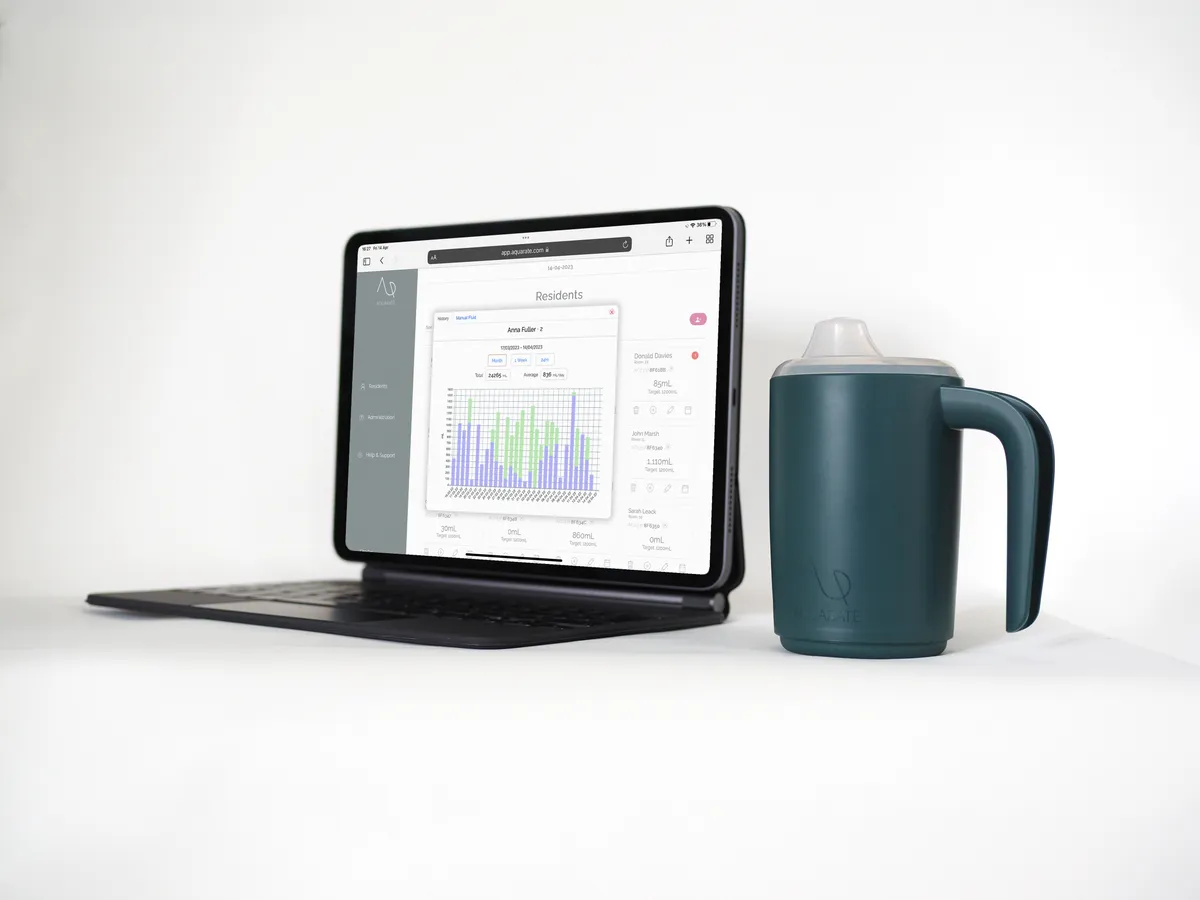
A cup that has to survive constant industrial dishwashing, and didn’t. We took it from a 2% baseline — 98% of units failing within 24 hours across a 250-cup care-home deployment — to 97% field reliability across the first 1,000 production units, and into volume production.
The outcome
2% to 97%
field reliability
Aquarate’s fluid-tracking cup for care homes has to survive constant industrial dishwashing. It didn’t: across a 250-cup deployment in a real care home, 98% of units failed within 24 hours — a 2% baseline. We found the root cause and fixed it, taking the cup to 97% field reliability, confirmed on the first 1,000 production units, and into volume production.
The full story — the diagnosis, the three decisions, and the method behind them — is in the case study below.
What’s inside
The whole thing, 18 pages, no summary.
- The setting: a funded product, a committed launch date, and a device that gets washed constantly.
- The diagnosis: why there were two root causes, not one, and why neither had been caught.
- The fix: the three decisions that turned it around, and what each one cost.
- Before and after: what the trial showed, and what the field showed.
- The method: the part of this that transfers to your product, whatever it is.
- Accountability: who did what, named.
Get the case study
Name and email. Nothing else, and no newsletter.
Is your product about to meet the real world?
A short call, no pitch. Tell us where it is, and we will tell you honestly what we would test first.
Book a call (opens in a new tab)